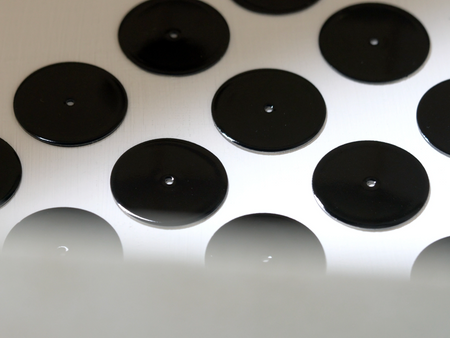
One of the oldest ceramic materials in use, porcelain is valued for its durability, clarity and depth of finish. While it has been used for centuries in fine ceramics, its application in watch dials has always been rare.
Historically, porcelain dials were prized for their clarity and permanence. Unlike painted or lacquered surfaces, the colour and finish are integral to the material itself and will not fade or oxidise over time. The material is, however, unforgiving. Shrinkage, warping and surface defects are common during firing, and many dials do not survive the process. As industrial techniques advanced, porcelain was largely replaced by faster, more predictable alternatives.
Among watch enthusiasts, enamel and porcelain are often used interchangeably but, despite their similarities (they are both handmade, kiln-fired materials), they are fundamentally different.
Our vitreous – or grand feu – enamel dials are made from a glass-based powder applied by hand to a metal disc, either by sifting or using a wet lay process. They are fired in a kiln at 840°C, where the enamel melts and bonds to the metal surface. Multiple layers are added until the desired thickness and finish are achieved.
By contrast, our porcelain dials consist of a clay body with a high-fired vitreous glaze. The clay body is composed of minerals such as silica and aluminium oxide and can be fired to temperatures of up to 1300°C. A vitreous glaze is applied to achieve the desired finish — whether opaque or transparent, satin or glossy — and fuses directly with the porcelain body. Colour is achieved through the ingredients within the glaze; for example, black is produced by incorporating iron oxide.
In the kiln, the material behaves unpredictably. As it vitrifies and contracts, small variations in temperature or glaze thickness can lead to warping, surface defects or cracking, and many dials do not survive firing. Those that do survive retain subtle variations in texture and finish that are inherent to the process and impossible to replicate industrially.
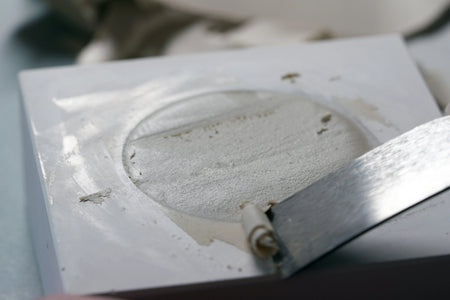
Dial blanks are formed from prepared clay and press-moulded before drying. Once glazed, they are fired at high temperature and allowed to cool slowly. Each dial is then inspected and carefully finished by hand to ensure the required flatness and surface quality before printing.
The dials are printed using traditional pad-printing equipment. They are then inspected under magnification and, if satisfactory, the ink is cured to ensure clarity and permanence.inspected under magnification and, if satisfactory, the ink is cured to ensure clarity and permanence. The completed dials are passed to our watchmakers for assembly. The watches are regulated and tested in six positions over 48 hours before being packaged and dispatched.
Two points of enamel are removed from the reverse of the dial, and dial feet are soldered to the exposed copper. These help secure the dial to the watch movement. The dials are printed using traditional pad-printing equipment. The printed dials are inspected through a loupe and, if satisfactory, the ink is then cured. You can learn more about our dial printing here
The completed dials are passed on to our watchmakers, who can begin assembly. The watches are regulated and tested in six positions for 48 hours before they are ready to package and dispatch.